
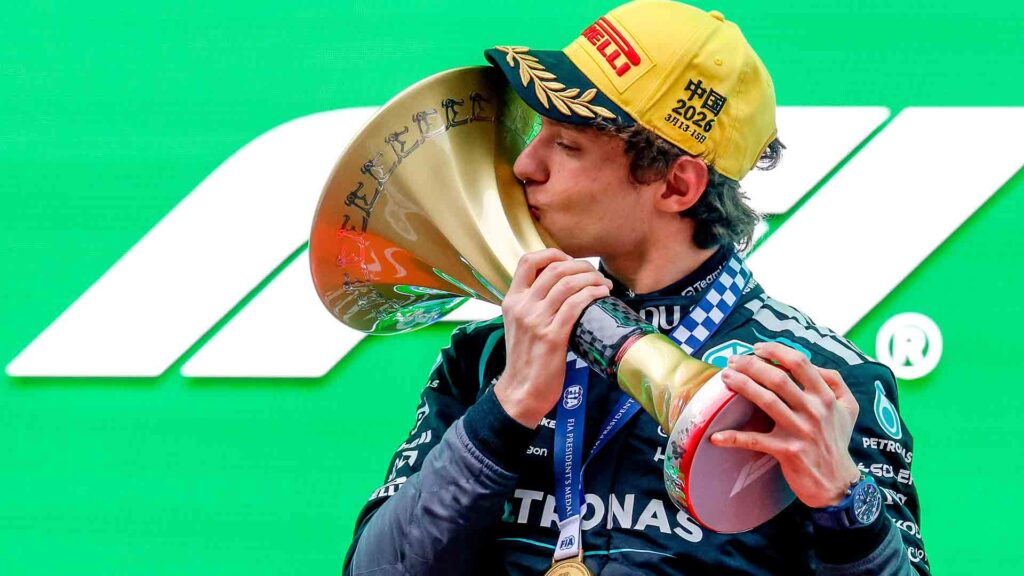
The 2026 Chinese Grand Prix confirmed that the new Formula 1 season has already entered a decisive competitive phase. In Shanghai, Andrea Kimi Antonelli claimed his maiden win in the category and led a Mercedes one-two ahead of George Russell, while Lewis Hamilton secured his first Ferrari podium in third. Further back, Oliver Bearman impressed again with fifth place for Haas, while Max Verstappen retired with a power unit problem after a very difficult weekend for Red Bull.
Kimi Antonelli: the win that changes the scale of the story
Antonelli’s race carried both competitive and symbolic weight. The Italian not only took his first Formula 1 victory, he also became the first Italian to win a Grand Prix since Giancarlo Fisichella in 2006 and the second-youngest race winner in F1 history, behind only Verstappen. More important than the symbolism was the way he managed the race: no excesses, no mistakes, and enough maturity to turn Mercedes’ pace into the maximum result. China stopped being just the scene of his arrival; it became the race where Antonelli gained real stature as a major contender in Formula 1’s new technical cycle.
Mercedes: authority, execution and a benchmark start to the season

If Antonelli was the star of Sunday, Mercedes was the big strategic winner of the weekend. The team took victory with the Italian, placed Russell second, and headed to Suzuka with two wins from the first two main races of 2026, plus Russell’s triumph in the Chinese Sprint. The key reading goes beyond the one-two finish: Mercedes appears to have found a very strong competitive window under the new regulations, combining speed, consistency and reliability. In a season where technical adaptation means everything, leaving China with this level of control puts the team in a clearly powerful position.
Ferrari: first podium with Hamilton, but still not controlling the race


Ferrari left Shanghai with mixed, though broadly positive, signals. Hamilton finished third and secured his first podium for the Scuderia, while Charles Leclerc was fourth, confirming that the SF26 was part of the leading group for virtually the entire race. Even so, Ferrari’s competitive picture still calls for caution: the team was strong enough to fight for the podium, but not strong enough to truly interfere with Mercedes in the battle for victory. The result brings confidence and momentum, especially on Hamilton’s side, but it also shows Ferrari remains one step short in race control and in delivering a fully commanding Grand Prix weekend.
Oliver Bearman: the most consistent breakout of the early season
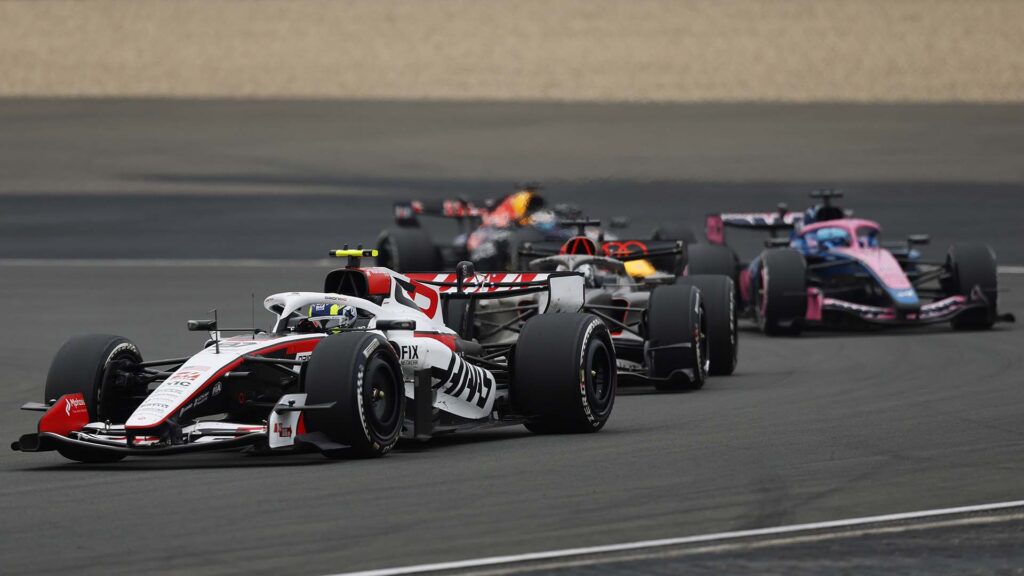
In a midfield increasingly defined by detail, Oliver Bearman stood out again. The Briton drove the Haas to fifth place, was the best driver outside the top three teams, and once more confirmed the impression created at the start of the season: Bearman is not just collecting good results, he is building a very solid championship opening. Formula 1 labelled him “best of the rest”, and rightly so: on a weekend where the midfield battle was intense, the young Briton stayed ahead and reinforced Haas’s excellent competitive momentum, with the team seemingly taking a genuine step forward in race pace for 2026.
Max Verstappen: retirement, frustration and warning signs at Red Bull

If Mercedes came away strengthened, Red Bull left China with both a sporting and political problem. Verstappen retired on lap 46 with a power unit issue and afterwards once again blasted Formula 1’s new technical era, calling the situation a “joke”. The Dutchman had already shown strong discomfort with the car’s behaviour during the weekend, even describing it as “completely undriveable” after qualifying. His retirement in Shanghai was not just a zero in the points column; it exposed a team still far from the balance required to fight for the championship at the start of this new cycle. From a narrative standpoint, it was one of the biggest defeats of the weekend.
Shanghai offers clear clues for the rest of the season
China was only the second round of the championship, but it produced strong conclusions. Antonelli moved from prospect to winner; Mercedes left Shanghai as the benchmark; Ferrari banked a useful but still incomplete result; Bearman confirmed himself as one of the most serious stories of the opening phase; and Verstappen saw his season enter a tense zone very early. More than an isolated Grand Prix, Shanghai felt like a defining moment in the pecking order — and in a Formula 1 landscape undergoing major change, that may matter far more than the raw points table alone.