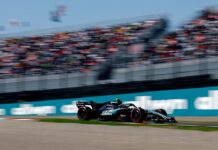









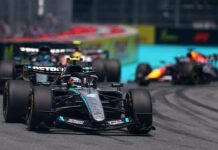




Qualifying for the Japanese Grand Prix confirmed an idea that has been building since the start of the season: Mercedes arrives at Suzuka with the strongest overall package. Andrea Kimi Antonelli claimed pole position with a 1:28.778, beating team-mate George Russell by less than three tenths and locking out the front row for Mercedes. It was the young Italian’s second consecutive pole, following his P1 in China.
If Antonelli’s pole was impressive for the lap time, it was even more impressive in context. The Italian had looked strong all weekend and once again delivered when it mattered, while Russell maintained the consistency that has defined his start to 2026. Mercedes not only secured the front row but again showed strong balance between one-lap pace, confidence through direction changes and overall control at a circuit as demanding as Suzuka.
Behind Mercedes, McLaren confirmed itself as the main challenger. Oscar Piastri put his car third, just 0.054s behind Russell, while Lando Norris completed the top five, just behind Charles Leclerc. The picture is clear: the Woking team is closer to the front than it was in previous rounds, but still not quite able to turn that pace into pole. Splitting the two McLarens, Leclerc took fourth and kept Ferrari directly in the fight for the top three.

Lewis Hamilton, in sixth, completed a strong Ferrari presence in the top 10, even if the Scuderia once again leaves qualifying with the sense of being present but not dominant. From there, the session moved into especially interesting territory: Pierre Gasly put Alpine seventh, ahead of Isack Hadjar in eighth for Red Bull, while Gabriel Bortoleto delivered an excellent ninth place for Audi. Arvid Lindblad rounded out the top 10 for Racing Bulls in one of the standout stories of the session.

That top 10 also tells an important story beyond the obvious names. Gasly once again extracted everything from a competitive Alpine in medium- and high-speed sectors. Bortoleto placed Audi in Q3 and reinforced the strong impression he has made at the start of the year. And Lindblad achieved what many rookies take months to reach: a natural place among the ten fastest at a circuit that punishes mistakes mercilessly.
But perhaps the most telling detail of the session was the name missing from the top 10. Max Verstappen was knocked out in Q2 and failed to reach the pole shootout, eliminated in the final moments by Lindblad. The fact that the four-time champion and winner of the last four Suzuka races did not reach Q3 says a great deal about the shift in competitive order exposed by this session. Right now, Mercedes looks like the benchmark, McLaren is alive, Ferrari remains close, and the midfield fight is tighter than ever.
For the race, the grid leaves a clear picture: Antonelli starts as the natural favourite, Russell as the immediate internal threat, Piastri as the first real candidate to break Mercedes control, and Leclerc and Norris as drivers to watch closely. Suzuka once again rewarded precision, confidence and commitment — and on Saturday afternoon, no one brought those three elements together better than Antonelli.